
The Medieval Institute is pleased to present our Fall 2025 Alumni Spotlight. In this series we feature the career paths of medieval studies alumni. Look for a new installment each semester, and follow our weekly news features regarding Medieval Institute-supported programming, events, and guest lectures on our news and events feed.
This semester's alumni spotlight features Dr. Julia Schneider, who is the Hesburgh Libraries' Subject Specialist for Medieval Studies as well as the Scholarly Resources and Assessment Librarian for Arts, Humanities, and Architecture. She also serves as the subject liaison for German Language and Literature. Dr. Schneider completed her Ph.D. in Medieval Studies at Notre Dame in 2011, concentrating on liturgy, theology, and intellectual history. Her dissertation was titled “Liturgy and Theology in De mysterio missae, a Thirteenth-Century Commentary on the Liturgy Attributed to Albertus Magnus,” and was completed under advisors Thomas Prügl and Calvin Bower. Most recently, Dr. Schneider received the Rev. Paul J. Foik, C.S.C., Award, which recognizes a Library faculty member who has advanced the profession through personal scholarship, leadership in an external organization, or other national service or academic distinction.
We asked Dr. Schneider to share some thoughts on her work and time at Notre Dame.
Why did you decide to study the Middle Ages here at the Medieval Institute?
My major fields are theology, liturgy, and intellectual history. I took some classes in undergrad as well as in my master's work about theology, which led me to the study of the Middle Ages. There's a richness of theological reflection in the Middle Ages. There's a richness in the liturgical tradition—the prayers, the forms, the music. It's all still developing, and there's a lot going on, a lot to deeply understand. Medieval liturgy is rich on many different levels, artistically and aesthetically but also theologically and intellectually, so it hit upon all of the all the things that interested me. I was interested in all of those subjects apart from the Middle Ages, but studying them in the Middle Ages gave me a real understanding of where we are now and where we were before that.
Coming here was really a no-brainer. I had intended to pursue a Ph.D. at my master’s institution, Saint Louis University, but my then-advisor left to join the Dominicans. He was a graduate of the MI and suggested that I come here. I was attracted to the well-rounded state of the program. We had to take requirements in art or music. We had to study philosophy or theology. We had to have a solid background in Latin in order to pass our exams. We had to be able to work with manuscripts—if you're working in the Middle Ages, it's really hard to be able to do so without working with manuscripts at a deep level. I felt like this would be the best possible preparation, and the faculty that we had were amazing, so I was really grateful to be admitted.
In your time at the Medieval Institute, what's changed and what hasn't?
One thing that's continued throughout my time here is that sense of community: community among the grad students, community among the faculty fellows and affiliated faculty, and the way that those groups interact. It still feels like home to me, almost as much as a family home, because I've been here for so long. But there's always room to grow and change, which is part of being part of a family. Although there are some things that have changed—we don't have as many grad students as we did back in my day—the basics are still there. We have our kitchen, and the carrel room is still as it was when I was here, although a bit refreshed. In terms of things that have changed, the disciplines have changed. The people who are coming in are coming from different places, so that enriches the community as well.
What’s the most intriguing element of your work in medieval liturgy?
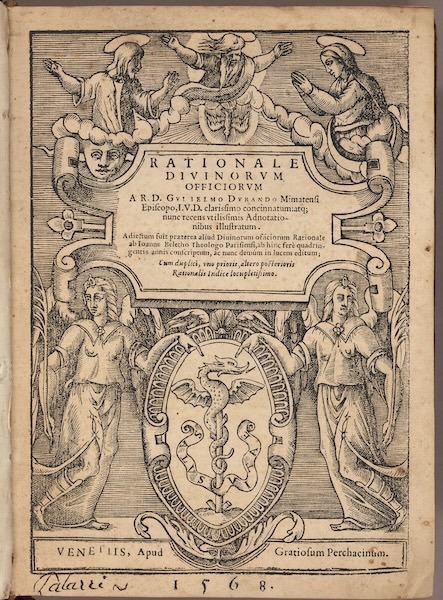
Liturgical commentaries really drew me in. These are commentaries written about the reason for and the basis of different liturgical practices, and they also intersect with other kinds of commentaries from the time, for example, biblical commentaries. There's often a layered interpretation of the literal and allegorical. Liturgy also follows the trajectory of education, so you get parallels between biblical commentary, biblical studies, and canon law studies, and these commentaries are sandwiched somewhere in between. Interestingly, the style of commentary is the same across all of these genres—genre divisions which we've supposed in modernity.
Liturgical commentaries also tell us what people might have been reading, and what they might have used these texts for. And it’s not just one style of commentary or one type of source. These commentaries give us deep insight into a larger picture, into, say, theological education at the University of Paris in the 13th century. The more puzzle pieces we can fit into learning about that intellectual history and history of education, the better we understand the way medieval people thought and how they were educated.
What led you to library work after completing your Ph.D.?
Before I went to grad school, I had actually thought about library school. I'd always been interested in that as a possibility. In library work, I could to use all the deep disciplinary and interdisciplinary learning that I had in a different way, one which might be more influential and have a longer lasting impact. I wanted to help other medievalists. One of the things that I really enjoy about it is getting to use the sources that I learned how to use as a grad student, and helping other people find what they need to do the work they want to do.
We have so many resources here at the Medieval Institute library; it's fabulous. It's the best place for medieval studies, I would argue, in North America, and perhaps in the world, just because of the level of access that we have. There might be libraries that have more things than we do, although probably pretty few. They're not centralized, and they won't necessarily have everything that we'll have. But here you can walk around and take whatever you need off a shelf, check all your footnotes, complete your whole research checklist with every resource at your fingertips. It is a really wonderful place to work for that reason, but I would argue that ultimately, the thing that makes the Medieval Institute what it is and what it has been is the people: the folks who work in the offices, the director and associate director who guide the programs, the library staff down to the shelvers (those are the people who do the really important work), the grad students, and the faculty.
Tell us about your work on the Ambrosiana project.

This is a unique relationship. At Saint Louis, they have the Vatican Film Library, a project done with the sponsorship of the Knights of Columbus a long, long time ago—before World War II—to microfilm certain types of manuscripts (Aquinas-related manuscripts in the Vatican and some others) so that they would be preserved, and so that scholars would have access to them without actually having to come in contact with the original artifacts. Consequently, I was already familiar with that type of a project before I came here.
The difference between the two is that the project here began with a relationship between Father Hesburgh and Cardinal Montini, who later became Paul VI. The original idea was to microfilm as many of the Ambrosiana Library's medieval manuscripts as we could. With the VFL, those are all Latin manuscripts. The ones that we have in the Ambrosiana collection are multilingual. Many of them are Latin, but there are also Greek manuscripts, and there's a huge fund of Arabic manuscripts and manuscripts in all of the European vernaculars. We have so much to study there.
Today, scholars from around the world come to visit the collection and, in a continuation of that relationship between Fr. Hesburgh and Cardinal Montini, I’m trusted by the Ambrosiana dottori to connect those scholars with our microfilmed collections. Along with the MI, the director of the MI, and the Dean of the Hesburgh Libraries, I maintain institutional ties with the Ambrosian Library. That includes the modern digitization projects that have superseded microfilming. We also work to publicize aspects of the project that aren't as well known, like the Ambrosiana Drawings project.
We have so many resources here at the Medieval Institute library; it's fabulous. It's the best place for medieval studies, I would argue, in North America, and perhaps in the world, just because of the level of access that we have.
What are some of your favorite memories from your time at the Medieval Institute?
When I was a grad student, I was regularly riding the elevator with Father Hesburgh and getting asked what I was working on. One time, I was tapped to read to him, because he had lost a lot of his vision—he had macular degeneration.
Some of the scholars that we grad students got to meet at the MI as invited lecturers were our heroes in our disciplines. The top Thomist in the world, for example, would come and give a lecture, and we would have graduate seminars the day after and really be able to interact with them. I know that that still continues for the grad students today, and it's a great opportunity.
Another favorite memory is the graduate student customary and having that document which helped guide our self-governance. We knew that we were the only group of grad students in the school who governed themselves and whose department was so confident in their documentation and their ability to handle it. I know that's still the case. Having that rich institutional history is something that I connected from the very beginning, and I still see that in our students today. It provides stability as a grad student in a world where you don't necessarily have a lot of stability, and it reinforces that feeling of community.
Originally published by at medieval.nd.edu on November 10, 2025.