 Bj 9
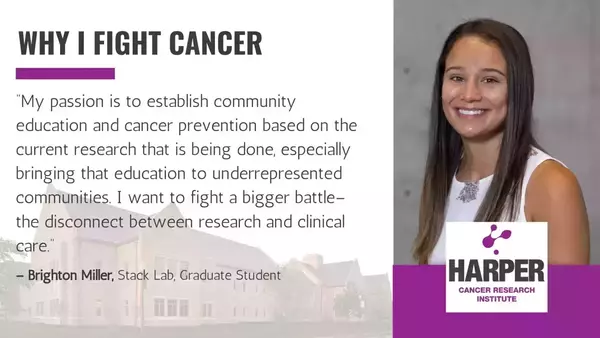
“My passion is to establish community education and cancer prevention based on the current research that is being done, especially bringing that education to underrepresented communities. I want to fight a bigger battle–the disconnect between research and clinical care.”
Brighton Miller, doctoral candidate at the University of Notre Dame, aims to bridge the gap between the way cancer is studied and the way it is treated, mending the broken path between research and community education. She is seeking a Ph.D. in Integrated Biomedical Sciences, but even greater than that, she is seeking to advance scientific knowledge of cancer so that it can be translated into education, prevention, and treatment in the wider community.
Throughout Miller’s adolescence, cancer was omnipresent. As diagnoses afflicted her classmates, coaches, and family, and claimed the lives of people close to her, Miller began to feel the weight of cancer’s presence and its devastating consequences. These consequences were especially prevalent within her family’s Native American community, a group which has long been underserved in the realm of cancer prevention and education. It was in high school that Miller began to question how she could make an impact not only in the fight against cancer itself, but also against the lack of cancer education that burdens many marginalized communities.
Early on, Miller considered going into medicine and working directly with cancer patients. Upon beginning her research journey, however, Miller realized that the field of research and exploration was the path for her. “I love the meticulousness of research,” she explained, but beyond her obvious passion for scientific inquiry, Miller realized that research, not bedside treatment, would “better address the root of the issue,” the disconnect between research and clinical care.
Once she chose to pursue the former, Miller participated in research internships, studying medical science in early diagnostic techniques for pancreatic cancer as well as inhibitors and vaccines for COVID-19.
These internships helped prepare Miller for the current work that she is doing at Notre Dame: studying the way that aging affects the prognosis for women with ovarian cancer. Miller’s lab is studying aging and senescent cells, and the feasibility of combating these risk factors using senolytic drugs
Miller’s affinity for meticulousness works in her favor in her current studies. “It doesn’t matter if I’m sick or tired or busy, I need to be there,” said Miller. But no matter how arduous her research is, the organization and discipline that she has learned and gained through her work is paying off.
“I feel like my work is very close to the next step: the bridge to actual clinical practices,” says Miller, “Science is so rewarding. You always feel like your work means something.”
To Miller, her work means everything. Teaching members of her Native American community about cancer prevention means everything. Working to save them, and other marginalized communities, from life-threatening knowledge gaps means everything. Fighting cancer through research, so that it cannot claim any more innocent lives, means everything.
As she looks forward to a profession in clinical research, Miller is proud to be where she is today: in a prestigious graduate program at Notre Dame, in a lab designing her own studies, and in a position where she can truly “fight a bigger battle” against cancer.
Originally published by at harpercancer.nd.edu on January 20, 2026.