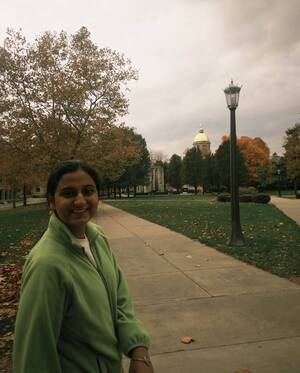
Before Phani Devarakonda makes a decision, she does her research. Fortunately, that’s something she’s good at. Before applying to graduate school, she spent seven years working as a research assistant to make sure getting a Ph.D. was the right choice for her. Knowing how time-intensive and resource-intensive Ph.D. programs are, she wanted to be absolutely sure.
Ultimately, it was her time working in the Bharti Institute of Public Policy (BIPP) research group at the Indian School of Business (ISB) that made up her mind. At ISB, she was part of a research group that used data-driven analysis to engage with policymakers on public policy challenges, particularly in agriculture, climate change, and environmental governance. “I was surrounded by researchers from diverse domains working collaboratively on real-world problems,” she says. “Seeing research inform policy and lead to tangible outcomes for communities and the environment made me realize this wasn’t just interesting—it was work I wanted to pursue long term.” She also realized that answering the deeper questions behind these outcomes required the kind of training and intellectual independence that only doctoral study could provide.
With a clear decision to pursue doctoral training, Phani then focused on finding the right institution. Two factors mattered most to her: a strong fit with a Ph.D. advisor and opportunities for meaningful research collaboration. Notre Dame offered both, making it her top choice. This fall, she began her first semester as a Ph.D. student in sustainable development, at the Keough School of Global Affairs, working in Professor Daniel Miller’s research group.
Her work in the Miller Research Group felt like a natural continuation of the questions she had been developing through her earlier research. The group’s work examines the links between conservation and development with a focus on the key role that political factors play in shaping the implementation and impacts of interventions. That fit allowed her to quickly begin engaging in collaborative research during her first semester.

As a graduate student in the Miller Research Lab, Phani is part of an ongoing collaborative research project connected to the Pulte Institute for Global Development. Through this work, she participates in interdisciplinary research meetings with faculty across the Keough School of Global Affairs, the Department of Economics, and partner universities. The collaboration has included work on a research paper submitted to a journal this fall.
Her first semester also included another milestone: presenting at FLARE 2025 in Lima, Peru. This international conference served as the annual meeting for the Forests & Livelihoods: Assessment, Research, and Engagement (FLARE) Network, an organization run by Professor Miller. “I shared preliminary work and received feedback from scholars whose work I’ve followed for years,” she says. The experience reinforced for her that Notre Dame not only supports graduate research, but actively creates pathways for students to engage globally.
Some of the biggest assets she’s relied on when it comes to her research are the Office of Grants and Fellowship, graduate training programs, and the free research databases at the Hesburgh Library. Through the Graduate School’s graduate training programs, she has participated in workshops focused on research communication, professional development, and mentoring, helping her build skills alongside her academic work. She has also received guidance from the Office of Grants and Fellowships, which has helped her identify and prepare for internal and external funding opportunities that support research, conference travel, and broader professional development. In addition, she has relied on the Hesburgh Library, which provides access to a wide range of academic journals, books, and databases essential for her research. She notes that the library’s subject librarians have been especially helpful in navigating these resources and identifying relevant literature for her work.
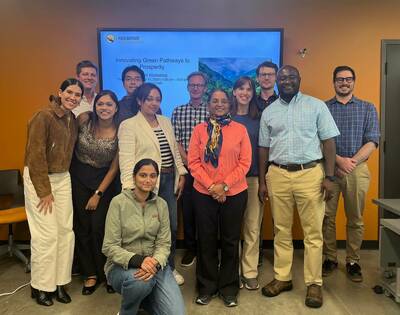
And then there are the smaller things that Phani shares that make all the difference, like the Graduate Student Emergency Support Fund or the restorative “break room” at St. Liam’s Hall. There are also social opportunities she’s taken advantage of, from a painting club to a book club to Notre Dame football games. All these resources and activities, combined with the fact that she has full five-year funding, has transformed Phani’s experience as a graduate student. “As an international student who is always thinking about money, they just took money out of the picture, so I can now work on my research.”
For Phani, choosing the right institution and advisor has been central to shaping her research path. Reflecting on her first semester, she’s confident that Notre Dame has been the right fit for her research goals—and she’s eager to tell others of the opportunities that await.
“Come to Notre Dame. If you want a university that values your potential, come to Notre Dame. If you want research collaborations, you have it. If you want access to high-performance computing, you have it. If you want to take career development courses, you have it here. You name it, you have it here.”
Originally published by at global.nd.edu on December 15, 2025.